Urban Naxals: The Making of Buddha in a Traffic Jam by Vivek Agnihotri
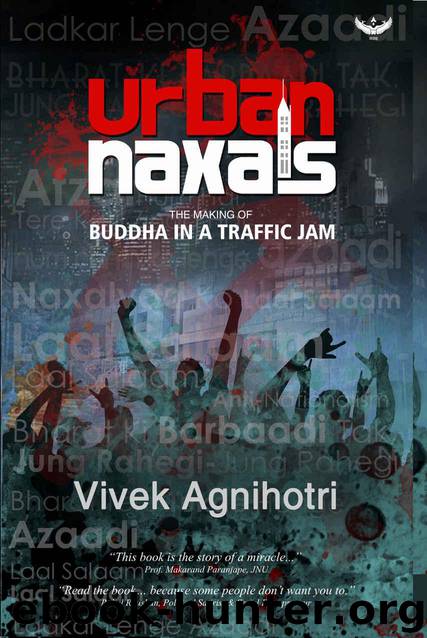
Author:Vivek Agnihotri
Language: eng
Format: azw3, epub, mobi
Publisher: Garuda Prakashan
Published: 2018-06-18T22:00:00+00:00
31. Technology: The Second Pillar of Cinema
The road from Hyderabad airport to ISB is world class. It feels like my own private road. Intermittently, a few cars overtake us and disappear ahead in no time. In a crowded country like India, people love to speed up on such roads. But my chauffeur is not accelerating over seventy kilometres. I ask him why he can’t speed up on an empty, four-lane highway.
‘Saar, not allowed,’ he replies in his Telugu accent.
‘But who is going to notice?’ I ask him, looking towards the barren land all around.
‘Saar, it’s a rule.’
‘But everyone is going over hundred… I am sure even you can.’
‘Saar, it’s a company rule.’
Instinctively, I know I must not talk him into breaking the rule.
One big problem with India is that people do not care about the law. They don’t follow rules because nobody gets caught. And in that rare chance, if they do get caught, everyone knows they can get off easily either by bribing or using a jugaad.
This driver is a man of integrity. Integrity isn’t just honesty. Integrity is being honest even when nobody is watching. India needs such collective integrity for it to shine. We can be a developed nation but in order to become a civilized nation, we need citizens to follow rules. Because when you break rules, you make the system ineffective, inefficient, and unproductive.
‘How long have you been working with your company?’ I ask him.
‘Twenty years.’
‘In twenty years you haven’t broken any rule?’
‘I tried my best not to.’
Rest of the forty-five-minute journey I think about the hidden philosophy behind the driver’s simple maxim: ‘I try my best not to break rules’.
Normally, we are told from our childhood ‘don’t do this… don’t do that,’ so often, that we actually want to break rules. In independent India, instead of building our own indigenous communication tactics we follow the authoritarian ways of the British, which was based on the carrot and stick style of management. People follow rules not because they want to but because they fear the stick. That’s why when we jump the red light, we check if there is a cop on the other side or not. Cops also hide behind trees or in a blind spot to get a sadistic pleasure in catching the offenders. A little shift from ‘Do this else…’ to ‘try your best not to break rules’ can motivate more people to follow rules and increase the effectiveness of the system.
When I get down at ISB, I want to tip the driver but he refuses.
‘Against the rules, saar.’
‘I insist… for your kids,’ I try to persuade him, lure him.
He takes out a small piggy bank of CRY, an NGO working for homeless children, and asks me to put the tip in it. I put the money in his piggy bank and leave thinking that this world has been running because of some very good people.
Ravi tells me that he has tried all his avenues to raise the fifty lacs but in vain.
Download
Urban Naxals: The Making of Buddha in a Traffic Jam by Vivek Agnihotri.epub
Urban Naxals: The Making of Buddha in a Traffic Jam by Vivek Agnihotri.mobi
This site does not store any files on its server. We only index and link to content provided by other sites. Please contact the content providers to delete copyright contents if any and email us, we'll remove relevant links or contents immediately.
| Anthropology | Archaeology |
| Philosophy | Politics & Government |
| Social Sciences | Sociology |
| Women's Studies |
The Secret History by Donna Tartt(19476)
The Social Justice Warrior Handbook by Lisa De Pasquale(12297)
Thirteen Reasons Why by Jay Asher(9127)
This Is How You Lose Her by Junot Diaz(7059)
Weapons of Math Destruction by Cathy O'Neil(6471)
Zero to One by Peter Thiel(5953)
Beartown by Fredrik Backman(5947)
The Myth of the Strong Leader by Archie Brown(5631)
The Fire Next Time by James Baldwin(5592)
How Democracies Die by Steven Levitsky & Daniel Ziblatt(5333)
Promise Me, Dad by Joe Biden(5230)
Stone's Rules by Roger Stone(5196)
A Higher Loyalty: Truth, Lies, and Leadership by James Comey(5091)
100 Deadly Skills by Clint Emerson(5026)
Rise and Kill First by Ronen Bergman(4906)
Secrecy World by Jake Bernstein(4890)
The David Icke Guide to the Global Conspiracy (and how to end it) by David Icke(4854)
The Doomsday Machine by Daniel Ellsberg(4627)
The Farm by Tom Rob Smith(4614)
